




The Framework Laptop 13 (recent USB4 / Thunderbolt-capable generations) is modular by design: Expansion Card bays take Framework modules, and any leftover USB-C / USB4 port can take a hub, dock, charger, or drive that speaks the right protocols. This guide only lists accessories with confirmed USB-C / USB4 / Power Delivery behavior that matches what Framework Laptop 13 owners actually plug in. It is not a MacBook M4 accessories list and not an iPad Air dongle kit (see /ipad-air-accessories-that-actually-work for that host).
Charging
Start with wattage, then port count. Framework's stock brick is enough for the chassis alone. Once you add a hub with PD passthrough, or charge a phone beside the laptop, a GaN cube with a clear single-port max matters more than marketing "total watts."
Best everyday 65W GaN
The Anker 735 Charger (Nano II 65W) is the daily brick that matches Framework Laptop 13's ~60W-class Power Delivery needs with a little margin. One USB-C port can deliver the full 65W; the second USB-C and USB-A share the pool when you also top up a phone.
✓ Pros
- ✓ Full 65W on a single USB-C port for Framework-class notebooks
- ✓ Tiny GaN body with foldable prongs for bags
- ✓ Street price near $25 with a huge review volume
✕ Cons
- ✕ Shared 65W pool throttles when three devices charge at once
- ✕ No cable in the box (use a rated USB-C PD cable)
- ✕ Not enough headroom for two laptops at full rate
Compatibility note: Confirmed USB-C PD charger suitable for Framework Laptop 13's typical ~60W input. Pair it with a USB-IF / e-marker cable if you charge through a hub. More travel GaN context: /gan-travel-charging-kit-everything-you-need.
Best multi-device / travel brick
When the desk also needs a phone and earbuds, the Anker 737 Charger (GaNPrime 120W) gives a 120W shared pool with roughly 100W available on one USB-C port. That covers Framework plus a second device without hunting for a second outlet.
✓ Pros
- ✓ ~100W single-port ceiling for laptop-first charging
- ✓ Two USB-C plus USB-A with dynamic PowerIQ allocation
- ✓ Foldable plug and ActiveShield monitoring for travel kits
✕ Cons
- ✕ Street price often near $65 to $76
- ✕ Shared wattage drops when two high-draw devices plug in together
- ✕ Larger than a single-port 65W cube
Compatibility note: USB-C PD up to ~100W on one port works with Framework Laptop 13 USB-C charging. Useful when a dock's PD passthrough needs a strong upstream brick. Head-to-head with another 100W class brick: /anker-737-vs-ugreen-nexode-100w.
Portable hub
One stick for hotels and cafes. A portable hub should add HDMI, a couple of USB-A ports, and PD passthrough without pretending to replace a Thunderbolt desk dock. Portable hub shortlist: /best-usb-c-hubs-2026.
Best portable hub
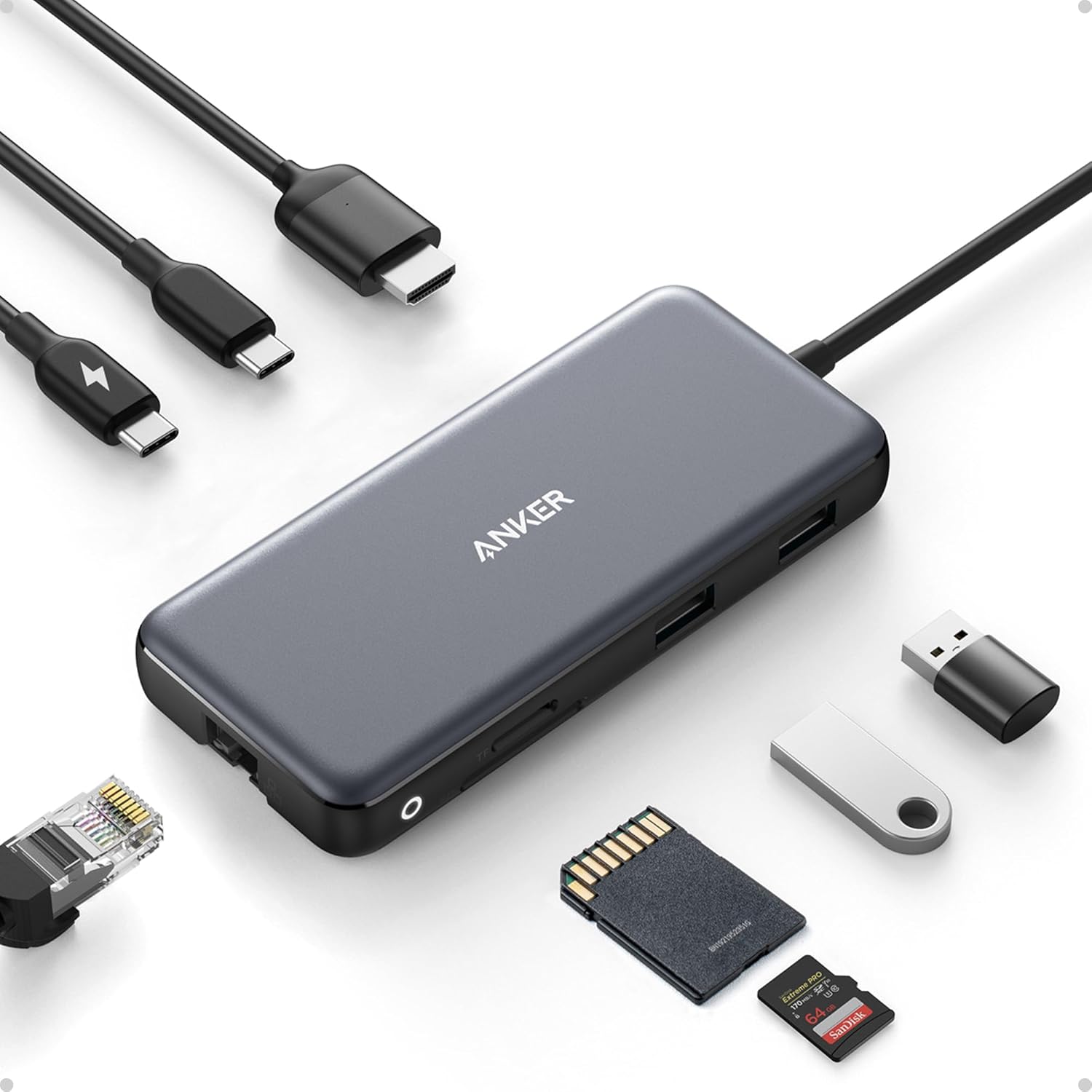
The Anker 555 USB-C Hub (8-in-1) is the bag pick: 4K60 HDMI on DP Alt Mode hosts, up to ~85W PD passthrough from a 100W charger, 10 Gbps data, Gigabit Ethernet, and SD/microSD.
✓ Pros
- ✓ 4K60 HDMI plus Gigabit Ethernet in one travel stick
- ✓ 10 Gbps USB-C and USB-A data ports
- ✓ SD and microSD when camera cards matter
✕ Cons
- ✕ Needs a strong 100W-class charger for meaningful laptop passthrough
- ✕ USB-C data port on the hub does not output video
- ✕ Runs warm under Ethernet + HDMI + charging load
Compatibility note: Works with Framework Laptop 13 USB-C / USB4 ports that expose DisplayPort Alt Mode and Power Delivery. Plug the hub into a USB-C Expansion Card or native USB-C module, not into a charge-only path.
Desk dock
USB-C dock for value, Thunderbolt / USB4 dock for the permanent single-cable desk. Desk docks in the Thunderbolt class are covered in depth at /best-thunderbolt-4-docks.
Best USB-C desk dock under $100
The UGREEN Revodok Pro 210 (10-in-1) is the affordable desk expander: dual HDMI (dual 4K60 class on supported Windows hosts), ~85W PD passthrough from a 100W input, Gigabit Ethernet, SD/microSD, and mixed USB-A/USB-C data.
✓ Pros
- ✓ Dual HDMI and Ethernet under $100 street pricing
- ✓ 100W PD in with meaningful passthrough for Framework-class loads
- ✓ SD + microSD plus multiple USB data ports
✕ Cons
- ✕ Plain USB-C dock, not Thunderbolt / full USB4 bandwidth
- ✕ Dual extended 4K depends on host GPU and OS limits
- ✕ Short fixed cable limits placement behind a monitor
Compatibility note: Confirmed USB-C docking station for USB-C / DP Alt Mode hosts including Framework Laptop 13. Prefer this when you want HDMI + Ethernet + charge on a budget and do not need Thunderbolt downstream devices.
Best Thunderbolt / USB4 desk dock
For a single-cable permanent desk, the CalDigit TS4 Thunderbolt 4 Dock is the premium pick: Thunderbolt 4 / USB4 host link, up to 98W host charging, DisplayPort 1.4, 2.5GbE, and a dense USB port field. Framework DIY USB4 modules are designed to interoperate with Thunderbolt 4 docks; treat dual-display claims as host- and OS-dependent.
✓ Pros
- ✓ Thunderbolt 4 / USB4 single-cable desk class
- ✓ Up to 98W host charging plus 2.5GbE
- ✓ Downstream TB4 and many USB ports for monitors and drives
✕ Cons
- ✕ Premium street price versus USB-C docks
- ✕ Needs a real USB4 / Thunderbolt-capable Framework module for full claims
- ✕ Overkill if you only need one HDMI and a couple of USB-A ports
Compatibility note: Framework Laptop 13 USB4 hosts work with Thunderbolt 4 docks such as the TS4. Use a certified Thunderbolt 4 / USB4 cable. If your batch only has USB-C (non-USB4) Expansion Cards, stay with a USB-C dock like the Revodok Pro 210 instead.
Storage and a simple HDMI path
Best portable SSD for the bag
The Samsung T9 Portable SSD 1TB is the compact USB-C drive for project folders and offloads. Peak 2,000 MB/s needs USB 3.2 Gen 2x2; on typical USB-C / USB4 laptop ports expect closer to 1,000 MB/s class speeds, which is still far ahead of a spinning drive.
✓ Pros
- ✓ Up to 2,000 MB/s sequential on Gen 2x2 hosts
- ✓ Compact, drop-rated case with cables in the box
- ✓ 5-year limited warranty and strong review volume
✕ Cons
- ✕ Full peak speed needs Gen 2x2; many hosts top out near 1,000 MB/s
- ✕ Cost per TB is high versus archival HDDs
- ✕ Some owner threads report disconnect cycles on certain Gen 2x2 desktop ports
Compatibility note: USB-C portable SSD that plugs into Framework Laptop 13 USB-C / USB4 ports. Prefer a direct host port (or a 10 Gbps hub port) over a slow USB 2.0 path on a cheap dongle.
Best direct USB-C to HDMI cable
When you only need one external display and zero hub bulk, the uni USB-C to HDMI Cable 6 ft (4K@60Hz) is the one-piece answer. It needs DisplayPort Alt Mode on the Framework USB-C port you choose.
✓ Pros
- ✓ True 4K60 over DP Alt Mode without a separate dongle body
- ✓ Braided one-piece cable for fewer failure joints
- ✓ Works on Thunderbolt / USB4 and DP Alt Mode USB-C hosts
✕ Cons
- ✕ Silent failure on charge-only USB-C ports without DP Alt Mode
- ✕ One-directional USB-C to HDMI only
- ✕ 6 ft is desk-side; longer runs need a dock or HDMI extension path
Compatibility note: Confirmed for USB-C hosts with DisplayPort Alt Mode, including Framework Laptop 13 USB-C / USB4 modules that advertise display output. If HDMI stays black, try a different Expansion Card bay or a hub with its own HDMI silicon.
Comparison
| Accessory | Role | Key link | Street price (approx.) |
|---|---|---|---|
| Anker 735 65W | Everyday GaN brick | USB-C PD ~65W | ~$25 |
| Anker 737 120W | Travel multi-device brick | USB-C PD ~100W single-port | ~$65 |
| Anker 555 8-in-1 | Portable hub | HDMI 4K60 + PD + Ethernet | ~$36 to $50 |
| UGREEN Revodok Pro 210 | USB-C desk dock | Dual HDMI + PD + Ethernet | ~$60 |
| CalDigit TS4 | TB4 / USB4 desk dock | TB4/USB4 + ~98W charge | ~$380 |
| Samsung T9 1TB | Portable SSD | USB-C / Gen 2x2 | ~$180 |
| uni USB-C to HDMI 6 ft | Direct display cable | DP Alt Mode 4K60 | ~$13 |
The Bottom Line
For a Framework Laptop 13 USB4 host, charge daily with the Anker 735 65W, pack the Anker 737 120W when the bag also feeds a phone, expand ports on the road with the Anker 555, and pick the UGREEN Revodok Pro 210 for a budget desk or the CalDigit TS4 when you want a real USB4 / Thunderbolt single-cable setup. Add the Samsung T9 for fast offloads and the uni USB-C to HDMI cable when one monitor is enough. Keep Expansion Cards for Framework-specific I/O, and use USB-C hubs and docks on ports that actually expose data, display, and Power Delivery.


