


Most "4K HDMI" travel hubs quietly mean 4K at 30 Hz. That is fine for slides, soft for video calls and scrolling a 4K monitor. This roundup only keeps portable USB-C hubs that advertise HDMI 4K60, stay under about $80 street, and still leave Power Delivery room for the laptop. It is not a Thunderbolt dock guide and not a DisplayLink dual-monitor brick list. For the broader portable-hub shortlist (including a clear 4K30 budget pick), see Best USB-C Hubs in 2026. Still deciding hub versus dock? Start with USB-C hub vs docking station. When one external display is not enough and you want a permanent single-cable desk, jump to Best Thunderbolt 5 docks instead of forcing a stick hub.
What to Look For
4K60 versus 4K30 is the filter. Listings that only say "4K HDMI" often mean 30 Hz. Confirm the product page says 4K at 60 Hz, and that your host USB-C port supports DisplayPort Alt Mode (ideally DP 1.4). Many DP 1.2 hosts still cap at 4K30 even on a capable hub. For the display-pipe glossary, see DisplayPort.
Mac versus Windows Alt Mode reality. Apple silicon MacBooks drive a single external display over USB-C/Thunderbolt Alt Mode on most Air/basic Pro configs. Windows laptops with MST-capable USB-C can sometimes fan out more, but a cheap portable hub is still usually a one-monitor tool. Dual permanent 4K60 is dock territory (or a Thunderbolt host with a real dock).
Power Delivery passthrough. A dedicated USB-C PD port (often 100W in, roughly 85W left for the laptop after hub overhead) keeps charge-while-presenting honest. Use a charger and cable that actually negotiate the wattage your notebook needs.
Port mix over raw count. Travel kits usually want HDMI + PD + a couple of USB-A, then choose Ethernet and/or SD based on the bag. Gigabit RJ45 matters in hotels. SD/microSD is convenience for camera dumps, not a studio reader.
Size and cable. Stick hubs with short captive USB-C cables travel better than desk bricks. If you need 80Gb/s Thunderbolt 5 bandwidth and 140W desk charging, that is a different product class (Thunderbolt, plus the Thunderbolt 5 docks shortlist and Thunderbolt cables).
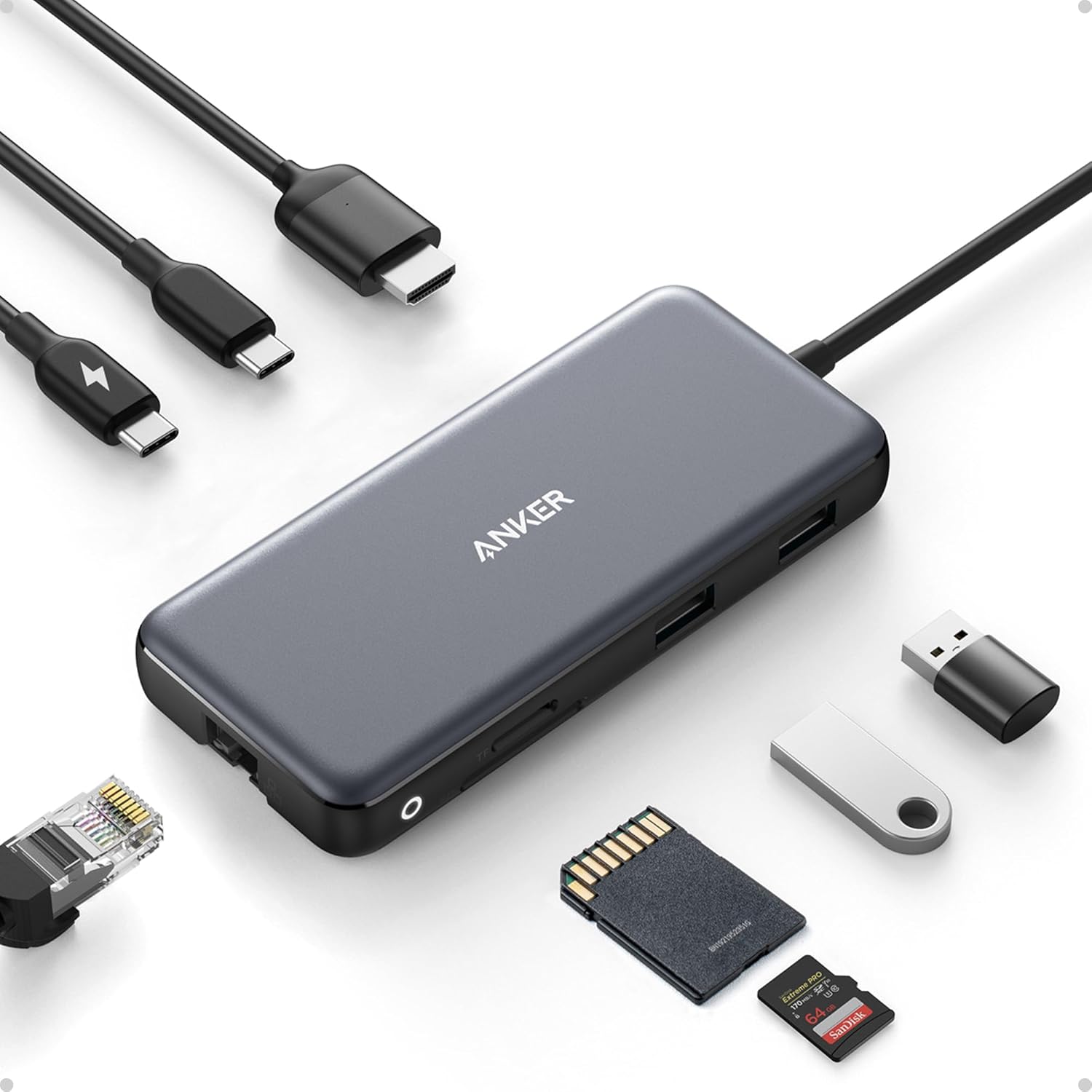
Best Overall: Anker 555 USB-C Hub (8-in-1)
The Anker 555 is the under-$80 checklist winner: HDMI up to 4K60 on DP 1.4 hosts, up to about 85W PD passthrough from a 100W charger, 10 Gbps USB-C and USB-A data, Gigabit Ethernet, and SD/microSD in one aluminum travel shell. It covers conference rooms and cafe days without stepping into full dock pricing.
✓ Pros
- ✓ Verified 4K60 HDMI plus Gigabit Ethernet in one portable stick
- ✓ 10 Gbps data ports for fast SSDs and sticks
- ✓ SD and microSD when camera cards matter
✕ Cons
- ✕ Needs a strong 100W-class charger to leave meaningful wattage for the laptop
- ✕ USB-C data port does not output video (HDMI only)
- ✕ Runs warm under Ethernet + HDMI + charging load
Who it is for: anyone who wants one under-$80 hub that covers 4K60 HDMI, wired network, cards, and PD. Who should skip it: dual-monitor permanent desks (get a Thunderbolt dock instead) or buyers who only need HDMI + PD and will not pay for Ethernet.
Best Value: UGREEN Revodok Pro 6-in-1
If Ethernet and 4K60 matter more than card slots, the UGREEN Revodok Pro 6-in-1 undercuts the Anker while keeping HDMI 4K60, Gigabit RJ45, 100W PD (about 85W through), and 10 Gbps USB-A/USB-C data. It is the price-to-ports winner for hotel Wi-Fi escapes.
✓ Pros
- ✓ Real 4K60 HDMI at a budget-friendly street price
- ✓ Gigabit Ethernet without stepping up to a dock
- ✓ 10 Gbps USB-A and USB-C data ports
✕ Cons
- ✕ No SD/microSD reader
- ✕ Buyer reports of USB ports failing after months on some units
- ✕ Can run warm under load
Catch: long-term reliability anecdotes are more mixed than Anker, Plugable, or Satechi, so treat it as a value pick you can replace cheaply if needed.
Best Reliable Build: Plugable USBC-7IN1E
The Plugable USBC-7IN1E is the IT-desk answer in this price band: HDMI up to 4K60 on DP 1.4 hosts, Gigabit Ethernet, SD + microSD, two USB-A 5 Gbps ports, and up to 100W PD passthrough (about 87W class to the laptop). Plugable publishes clear 4K60 requirements instead of burying them in marketing copy.
✓ Pros
- ✓ Clear 4K60 HDMI claims with DP 1.4 host requirements spelled out
- ✓ Gigabit Ethernet plus SD/microSD together
- ✓ Strong support docs for classrooms and fleets
✕ Cons
- ✕ USB-A tops out at 5 Gbps (no 10 Gbps data port)
- ✕ Only two USB-A ports versus three on some rivals
- ✕ Street price sits above the cheapest UGREEN/Baseus options
Who it fits: Windows and Mac travelers who want Ethernet + cards + honest 4K60 without gambling on no-name listings. Skip if you need 10 Gbps SSD dumps every day (Anker 555 or Revodok Pro).
Best Budget Travel: Baseus 7-in-1
The Baseus 7-in-1 is the slim bag filler that still clears the 4K60 bar: HDMI 4K60, 100W PD, three USB-A 5 Gbps ports, and SD/TF slots for camera dumps on the plane. It skips Ethernet to stay small and cheap.
✓ Pros
- ✓ 4K60 HDMI plus SD/TF in a compact body
- ✓ Very low street price for this port mix
- ✓ PD passthrough for day trips
✕ Cons
- ✕ USB-A tops out at 5 Gbps, not 10 Gbps
- ✕ No Ethernet
- ✕ Build and longevity feel more budget than Anker, Plugable, or Satechi
Best for photographers and students who need HDMI + cards + charge in one stick. Skip if you need wired Gigabit in hotels.
Best Premium Finish: Satechi Aluminum Multiport Adapter V2
The Satechi Multiport Adapter V2 sits at the top of the under-~$80 ceiling: aluminum "belongs next to a MacBook" finish, 4K60 HDMI, Gigabit Ethernet, three USB-A, SD/microSD, and up to 115W-class PD passthrough. You pay for polish and brand support more than exotic ports.
✓ Pros
- ✓ Premium aluminum shell and tidy Mac-adjacent design
- ✓ 4K60 HDMI, Ethernet, and card readers together
- ✓ Higher PD headroom (up to 115W class passthrough)
✕ Cons
- ✕ Street price near the $80 ceiling (often double the Anker 555)
- ✕ Still a single-monitor portable hub, not a dual-4K dock
- ✕ USB-A ports are 5 Gbps class, not 10 Gbps
Choose this when finish and brand polish are worth the premium. Choose Anker or Plugable when the checklist is the same but the budget is tighter. For a CalDigit-class desk comparison elsewhere on the site, see CalDigit TS4 vs Anker Prime 160W.
Comparison
| Hub | Ports (class) | HDMI | PD | Ethernet | Card reader | Street price |
|---|---|---|---|---|---|---|
| Anker 555 8-in-1 | 8 | 4K60 | ~85W through | Gigabit | SD + microSD | ~$39 |
| UGREEN Revodok Pro 6-in-1 | 6 | 4K60 | ~85W through | Gigabit | No | ~$25 |
| Plugable USBC-7IN1E | 7 | 4K60 | ~87W through | Gigabit | SD + microSD | ~$40 |
| Baseus 7-in-1 | 7 | 4K60 | 100W in | No | SD + TF | ~$10 |
| Satechi Multiport V2 | 8 | 4K60 | up to ~115W class | Gigabit | SD + microSD | ~$80 |
When to Get a Dock Instead
Buy a full docking station (or Thunderbolt 4/5 dock) when you need dual external 4K60 monitors, a permanent single-cable desk setup, or more than about eight downstream ports every day. A portable hub in this list is for bags, hot desks, and one external display. Hub-versus-dock framing lives at USB-C hub vs docking station. Thunderbolt desk docks are covered in Best Thunderbolt 5 docks.
The Bottom Line
Start with the Anker 555 8-in-1 if you want one under-$80 portable hub that covers 4K60 HDMI, PD, Ethernet, and cards. Take the UGREEN Revodok Pro 6-in-1 when Ethernet and 4K60 matter most and card slots do not. Pick the Plugable USBC-7IN1E for clearer 4K60 docs plus Ethernet and cards, pack the Baseus 7-in-1 for cheap travel with SD/TF, and stretch to the Satechi Multiport V2 when aluminum finish is worth the ~$80 ceiling.
Need the wider portable-hub mix (including 4K30 budget sticks)? See Best USB-C Hubs in 2026. Need a real desk dock instead? Jump to Best Thunderbolt 5 docks.


