



A desk NAS, mini PC, or Wi-Fi shelf does not need a 1500VA tower that fills half a cabinet. It needs a compact UPS that fits behind the monitor arm, rides out short blips, and (ideally) signals a clean shutdown before the battery dies. This page is for under-$150 footprint units aimed at that stack. When you should skip this lane and buy a big sine-wave tower instead, see APC BR1500MS2 vs CyberPower CP1500PFCLCD and the broader best UPS battery backups for NAS and network gear. For wiring auto-shutdown on Synology or QNAP, use UPS auto-shutdown with Synology, QNAP, and NUT and the HID UPS glossary page. A Mac mini Plex shelf that already budgets one compact sine UPS lives in the Mac mini M4 Plex UPS kit. Quiet apartment NAS shoppers can also skim the apartment quiet NAS Plex upgrade path.
What to Look For
VA vs watts. Marketing leads with VA. Your NAS, switch, and ONT draw watts. A 4-bay spinning NAS plus modem and AP often sits around 40 to 120W idle. Match continuous watts with headroom, then treat VA as a secondary label. Under $150, expect 260W to about 480W continuous, which is plenty for a desk stack and wrong for a full gaming PC.
AVR (automatic voltage regulation). Line-interactive units with AVR correct brownouts without dumping to battery. That matters in older apartments and rural feeds. Pure standby units (no AVR) are fine for clean municipal power and router-only shelves.
Simulated vs pure sine. Most compact under-$150 units output a stepped/simulated sine on battery. Active-PFC PSUs in some NAS and mini PCs complain (clicks, alarms, early shutoff). If reviewers of your exact NAS model report sine-wave requirements, budget for a compact pure-sine like CyberPower CP850PFCLCD when it is near $150, or jump to the 1500VA sine duel. Do not make a 1500VA tower Best Overall on this page.
Outlet count and spacing. Count battery-backed outlets, not surge-only. Wall-warts eat space. Prefer models with spaced outlets or a right-angle plug so the UPS can sit flush against a wall.
LCD and USB/HID auto-shutdown. An LCD that shows load % and estimated runtime helps you size the stack honestly. A USB HID data port (not just a charging USB-A) lets Synology, QNAP, TrueNAS/NUT, or PowerPanel trigger a clean shutdown. See HID UPS and the auto-shutdown guide. Charging-only USB ports do not replace a data cable.
Form factor. Desk NAS buyers want a short, shallow brick, not a deep mini-tower. Wall-mount keyholes help. Weight under ~15 lb is easier to hide on a shelf.
Best Overall: APC Back-UPS BE600M1
The APC Back-UPS BE600M1 is the default compact pick: 600VA/330W, seven outlets (five battery-backed), a USB-A charging port, and a footprint that fits behind a router or under a monitor arm. Runtime around 23 minutes at 100W is realistic for a low-power NAS plus modem. It is Best Overall here because it is widely stocked, under $100 street, and proven for desk stacks. It is not a HID shutdown UPS (no USB data port) and it is simulated sine without AVR, so pair it with light loads and manual or OS-level shutdown habits, or step up to a CP685AVRLCD-class unit when auto-shutdown is mandatory.
✓ Pros
- ✓ Compact APC chassis that fits a desk NAS shelf
- ✓ About 23 minutes at 100W for short outages
- ✓ Usually well under $100 with huge review volume
✕ Cons
- ✕ No USB HID data port for NAS auto-shutdown
- ✕ Simulated sine, no AVR
- ✕ Loud outage alarm with limited mute options
Who it is for: desk NAS, mini PC, and Wi-Fi gear under about 150W that need a trusted compact brick. Who should skip it: active-PFC PSUs that refuse simulated sine, and anyone who needs HID-triggered shutdown without adding NUT complexity elsewhere.
Best Budget Tiny: CyberPower ST425
The CyberPower ST425 is the smallest footprint in this list: 425VA/260W, eight outlets (four battery-backed), and a brick that disappears behind a media console. Buy it when the load is mainly modem, ONT, and maybe a fanless or SSD NAS. Runtime is short at higher loads (about 6 minutes at half load), so treat it as blip insurance, not a long outage rider.
✓ Pros
- ✓ Tiny and light for router-shelf installs
- ✓ Street price often near $60
- ✓ Eight outlets with basic surge coverage
✕ Cons
- ✕ Short runtime once you add a spinning NAS
- ✕ No AVR, no USB data port, non-replaceable battery on many units
- ✕ Simulated sine only
Best for modem/router priority with a very light NAS. Skip when you need LCD telemetry, AVR, or HID shutdown.
Best for Auto-Shutdown: CyberPower CP685AVRLCD
The CyberPower CP685AVRLCD is the compact line-interactive pick when the NAS must shut down cleanly: 685VA/390W, AVR, multifunction LCD, and a HID-compliant USB port for PowerPanel or NUT. That combination is what desk NAS owners actually miss on cheaper standby bricks. Output is still simulated sine, so confirm your NAS PSU behavior, but for Synology/QNAP auto-shutdown workflows it is the right under-$150 class.
✓ Pros
- ✓ LCD shows load and estimated runtime
- ✓ AVR reduces unnecessary battery cycles
- ✓ USB HID path for NAS/PC auto-shutdown
✕ Cons
- ✕ Simulated sine (not pure sine for stubborn PFC PSUs)
- ✕ Street price sits above BE600M1 and ST425
- ✕ Compact chassis still needs outlet planning for wall-warts
Best for Synology, QNAP, or TrueNAS desks that already follow the auto-shutdown guide. Skip if you only need modem blip protection (buy ST425) or need proven pure sine (budget for CP850PFCLCD when it dips near $150).
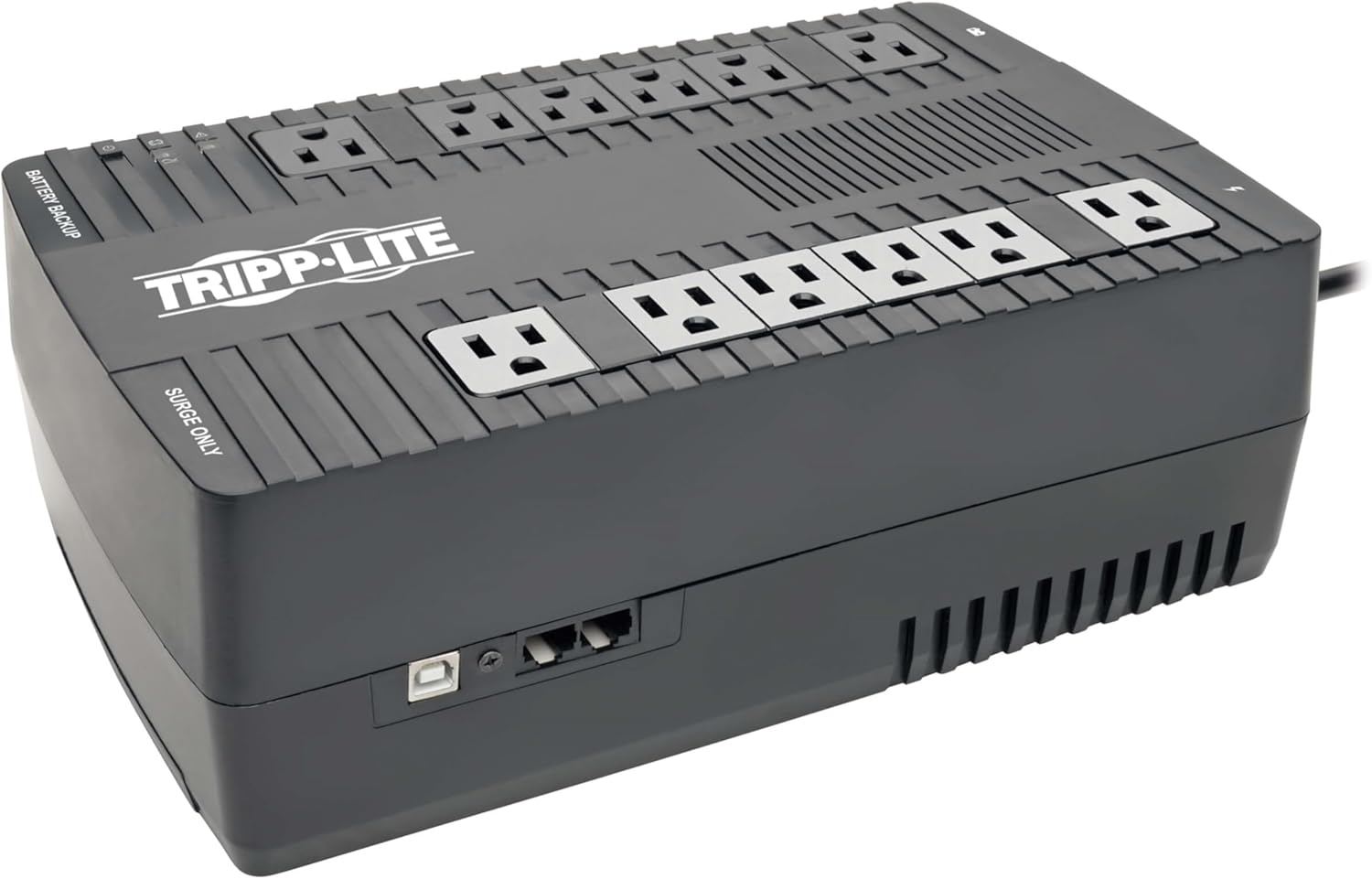
Best Value Capacity: Eaton Tripp Lite AVR900U
The Eaton Tripp Lite AVR900U stretches the under-$150 budget toward 900VA/480W with AVR, twelve outlets, a replaceable battery story, and USB management. It is the pick when the desk stack includes a NAS, switch, AP, and a mini PC that would crowd a 600VA unit. Ultra-compact Tripp Lite housing still fits a shelf better than a 1500VA tower.
✓ Pros
- ✓ 900VA/480W headroom under a $150 street target
- ✓ AVR plus USB for monitoring/shutdown workflows
- ✓ Twelve outlets for a full desk network shelf
✕ Cons
- ✕ Simulated sine wave on battery
- ✕ Larger than BE600M1 or ST425
- ✕ Fewer Amazon reviews than APC/CyberPower bestsellers
Best for multi-device desk shelves that outgrow 600VA. Skip when a tiny brick is the only thing that fits, or when pure sine is mandatory.
Best LCD Compact: CyberPower AVRG900LCD
The CyberPower AVRG900LCD is the LCD twin in the 900VA compact class: 900VA/480W, AVR, twelve outlets, and a front panel that makes load mistakes obvious. It is the buy when you want CyberPower PowerPanel software habits plus more watt headroom than the CP685, still without jumping into 1500VA tower money.
✓ Pros
- ✓ LCD telemetry at 900VA class capacity
- ✓ AVR and compact form factor
- ✓ Strong review volume for a desk UPS
✕ Cons
- ✕ Simulated sine, not PFC pure sine
- ✕ Heavier and deeper than BE600M1
- ✕ Price can flirt with the top of the $150 cap
Best for buyers who want LCD + capacity in one CyberPower brick. Skip if HID on a smaller 685VA unit is enough, or if you already prefer Tripp Lite outlet layout.
Comparison
| UPS | Capacity | Waveform / AVR | HID / LCD | Best use | Street price |
|---|---|---|---|---|---|
| APC BE600M1 | 600VA / 330W | Simulated, no AVR | Charge USB only / no LCD | Best overall desk brick | ~$83 |
| CyberPower ST425 | 425VA / 260W | Simulated standby | Neither | Tiny router shelf | ~$59 |
| CyberPower CP685AVRLCD | 685VA / 390W | Simulated + AVR | USB HID + LCD | NAS auto-shutdown | ~$127 |
| Tripp Lite AVR900U | 900VA / 480W | Simulated + AVR | USB + no LCD focus | Value capacity | ~$119 |
| CyberPower AVRG900LCD | 900VA / 480W | Simulated + AVR | USB + LCD | LCD capacity | ~$139 |
The Bottom Line
Start with the APC BE600M1 for a simple desk NAS shelf under $100. Move to the CyberPower CP685AVRLCD when HID auto-shutdown matters, or to the Tripp Lite AVR900U / CyberPower AVRG900LCD when the stack needs 900VA headroom. Keep the ST425 for modem-first blip insurance. When active-PFC PSUs reject simulated sine, leave this under-$150 compact lane and use the full NAS UPS roundup or the BR1500MS2 vs CP1500PFCLCD sine duel instead of forcing a tower into Best Overall here.


