
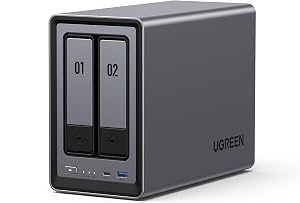

Choosing between the Synology 2-Bay DiskStation DS224+ (Diskless) and the UGREEN NASync DXP2800 2-Bay NAS (Diskless) is a same-bay fork, not a vague "best NAS" roundup. Both are diskless 2-bay chassis for home backup and media. One side is the classic DiskStation bet: Synology DSM, quieter maker noise, and a modest Celeron with dual Gigabit. The other is the value NASync bet: Intel N100, 8GB DDR5, 2.5GbE, dual M.2 NVMe slots, and younger UGOS Pro. Specs and street prices below come from manufacturer sheets and current Amazon listings, not a lab shootout.
Synology has replaced the DS224+ with the DS225+, and Amazon lists the DS224+ as currently unavailable. The DS225+ keeps the same Celeron J4125 platform, adds a 2.5GbE port and a third year of warranty, and sells for $300 to $400. Everything below about DSM applies to both Synology models, and the DS225+ section explains how it shifts the verdict.
This page is deliberately different from Synology DS225+ vs UGREEN NASync DXP4800 Plus, which compares a 2-bay DiskStation to a 4-bay 10GbE tower. Here both boxes stay at two SATA bays. For NAS basics, see What Is a NAS. For quiet apartment Plex paths that start on a 2-bay, see Apartment Quiet NAS Plex Upgrade Path.
| Attribute | Synology 2-Bay DiskStation DS224+ (Diskless) | UGREEN NASync DXP2800 2-Bay NAS (Diskless) | Synology DiskStation DS225+ 2-Bay NAS (Diskless) |
|---|---|---|---|
| Rating | 4.6 | 4.5 | 4.6 |
| Price | Not listed | $200-$500 | $200-$500 |
| CPU | Not listed | Intel N100, 4 cores, up to ~3.4 GHz | Intel Celeron J4125, 4 cores, 2.0 GHz (2.7 GHz burst) |
| RAM | Not listed | 8 GB DDR5, expandable to 16 GB | 2 GB DDR4, expandable to 6 GB |
| System storage | Not listed | Built-in 32 GB eMMC for UGOS Pro | Not listed |
| Network | Not listed | 1x 2.5GbE RJ-45 | 1x 2.5GbE + 1x 1GbE RJ-45 |
| Drive bays | Not listed | 2x SATA + 2x M.2 NVMe (diskless) | 2x 3.5"/2.5" SATA (diskless, drives sold separately) |
| Ports | Not listed | USB-C, USB-A, HDMI 4K | Not listed |
| Noise | Not listed | 29-34 dB quiet mode | 19.6 dB(A) |
| Warranty | Not listed | 2 years | 3 years |
| USB | Not listed | Not listed | 2x USB 3.2 Gen 1 |
| Rated transfer speed | Not listed | Not listed | 282 MB/s sequential read |
| Power draw | Not listed | Not listed | 16.98 W access / 6.08 W HDD hibernation |
| Dimensions | Not listed | Not listed | 165 x 108 x 232.2 mm |
| Weight | Not listed | Not listed | 1.3 kg (diskless) |
| Buy | Check price on Amazon | Check price on Amazon | Check price on Amazon |
Quick verdict
Most people shopping two equal bays should buy the UGREEN NASync DXP2800. At $300 to $400 diskless it brings an Intel N100, 8GB DDR5, 2.5GbE, and two M.2 NVMe slots that neither Synology matches on paper. Synology still wins when you want DSM polish, quieter maker noise, and Mac Time Machine to Synology habits. With the DS224+ out of stock on Amazon, that Synology is now the DS225+ at $300 to $400.
Price and value
Winner: UGREEN DXP2800 on hardware per dollar. Amazon lists both the DXP2800 (4.5 stars across 922 ratings, the #1 seller in NAS devices) and the DS225+ (4.6 stars across 229 ratings) in the $300 to $400 band, both diskless. The DS224+ (4.6 stars across 636 ratings) shows as currently unavailable, so there is no current new price to compare. Against the DS225+, the UGREEN costs only slightly more for far more CPU/RAM and two NVMe slots. Pay Synology's price when DSM is the product you are buying. Pay the small UGREEN premium when the chassis hardware is the product. Prices move, so confirm them before you order.
Bays and expandability
Winner: UGREEN DXP2800 inside the same 2-bay envelope. Both take two 3.5/2.5-inch SATA drives. UGREEN adds two M.2 NVMe slots for cache, apps, or a fast pool, plus DDR5 that expands to 16GB on this model and a built-in 32GB eMMC system volume so the OS is not eating a data bay. Both Synology models stay at two SATA trays with 2GB DDR4 (to 6GB) and no M.2 NVMe slots; the DS225+ did not add them. Neither is a four-bay growth story; if you already know you want four SATA trays and 10GbE, jump to the DS225+ vs DXP4800 Plus comparison instead.
CPU, RAM, and network throughput
Winner: UGREEN DXP2800 on hardware paper. Maker sheets list an Intel N100 (4 cores, up to about 3.4 GHz), 8GB DDR5, and 1x2.5GbE. The DS224+ uses an Intel Celeron J4125 (4 cores, up to 2.7 GHz), 2GB DDR4, and 2x1GbE with rated sequential reads near 225 MB/s. For Plex library scans, light transcodes, Docker stacks, and fat copies on a real 2.5GbE LAN, UGREEN is the throughput pick. For typical home backup on Gigabit Ethernet, both are enough on paper. Synology's dual LAN still helps link aggregation habits on older switches. The DS225+ swaps one of those Gigabit ports for 2.5GbE (rated near 282 MB/s), which closes the network gap but not the CPU/RAM gap.
| Axis | Synology DS224+ | Synology DS225+ | UGREEN DXP2800 |
|---|---|---|---|
| Bays | 2x SATA (diskless) | 2x SATA (diskless) | 2x SATA + 2x M.2 NVMe (diskless) |
| CPU | Intel Celeron J4125, 4c up to 2.7 GHz | Intel Celeron J4125, 4c up to 2.7 GHz | Intel N100, 4c up to ~3.4 GHz |
| RAM | 2GB DDR4 (to 6GB) | 2GB DDR4 (to 6GB) | 8GB DDR5 (to 16GB) + 32GB eMMC system |
| Network | 2x 1GbE (~225 MB/s rated) | 1x 2.5GbE + 1x 1GbE (~282 MB/s rated) | 1x 2.5GbE |
| Extra I/O | 2x USB 3.2 Gen 1 | 2x USB 3.2 Gen 1 | USB-C, USB-A, HDMI 4K |
| Noise (maker) | ~22 dB(A) | ~19.6 dB(A) | ~29-34 dB quiet mode |
| Weight (diskless) | ~1.30 kg | ~1.30 kg | ~2.58 kg |
| Warranty | 2 years | 3 years | 2 years |
| Amazon price (Sep 26, 2026) | Currently unavailable | $300 to $400 | $300 to $400 |
| Best fit | Only at a clear discount | Quiet DSM appliance | Value 2-bay hardware headroom |
How the DS225+ changes the verdict
The overall pick stays the UGREEN DXP2800, but the Synology side of the fork is now the DS225+. It is the same compact 2-bay DiskStation with the same Celeron J4125 and 2GB DDR4 (to 6GB), and it still has no M.2 slots. Three things change:
- Network: a 2.5GbE port joins the 1GbE port, so the UGREEN no longer wins on NIC speed alone.
- Warranty: 3 years against 2 years on both the DS224+ and the DXP2800.
- Price: both sit in the $300 to $400 band, so the gap to the DXP2800 is small, far narrower than the old DS224+ gap.
What does not change is the hardware gap. The N100 with 8GB DDR5, two NVMe slots, a separate eMMC system drive and HDMI output still make the DXP2800 the stronger box for Plex scans, Docker stacks and fast NVMe pools. So the decision is now cleaner: pick the DS225+ for DSM, quiet idle and the longer warranty, and pick the DXP2800 for hardware headroom at nearly the same price.
One caveat on drives: at launch the DS225+ fully supported only Synology-branded drives, and that is still the loudest complaint in its Amazon reviews. Synology restored support for mainstream third-party hard drives with DSM 7.3 in October 2025, so update DSM before you build the pool. For a 2-bay Synology against a 4-bay, 10GbE UGREEN, see DS225+ vs DXP4800 Plus.
Software ecosystem: DSM vs UGOS Pro
Winner: Synology (DS225+ or DS224+) for most non-tinkerers. DSM remains the polished package catalog for Hyper Backup, Photos-class libraries, Surveillance Station habits, and a huge how-to corpus. UGOS Pro gets frequent praise for a fast first setup and a cleaner modern UI, but owner reports still call out a younger app set and more Docker detours when you want Immich, Jellyfin, or niche tools. If you want appliance software that feels finished on day one, Synology wins. If you are comfortable with containers and will mainly use SMB shares plus a media stack, UGREEN's hardware can carry more of the load. For remote access without opening random ports, see Set Up Tailscale on a NAS.
Apps, backup, and Plex
Winner: Synology for backup apps and Mac habits; UGREEN for raw scan and transcode horsepower. Synology buyers repeatedly call out easy backups, Plex as a reliable target, and Mac Time Machine workflows. UGREEN buyers praise snappy library scans on the N100/DDR5 pool, HDMI local playback options, and Docker flexibility when the App Center is thin. Neither box ships with drives; budget NAS HDDs separately (see WD Red Plus vs Seagate IronWolf 4TB). For array rebuild vocabulary when a disk fails later, see Replace a Failed RAID Drive.
Noise, power, and size
Winner: Synology. Maker noise is listed near 22 dB(A) for the DS224+ and 19.6 dB(A) for the DS225+, both in a compact black 2-bay chassis of about 1.3 kg. UGREEN lists quiet-mode noise around 29-34 dB and weighs about 2.58 kg diskless in an aluminum shell that buyers often call solid, and sometimes a bit louder when large HDDs vibrate the chassis. If the NAS lives in a bedroom or living room, Synology is the easier roommate. If it lives in a closet or office shelf, UGREEN's fan and mass matter less.
Who should buy which
Buy the UGREEN NASync DXP2800 if you want the stronger 2-bay hardware package (N100, 8GB DDR5, 2.5GbE, dual NVMe) at a price only slightly above the DS225+, and you accept UGOS Pro's younger ecosystem.
Buy the Synology DS225+ if you want DSM polish, quieter idle, Mac backup habits and a 3-year warranty more than NVMe slots or N100 headroom. Buy a DS224+ only if you find one new at a clear discount to the DS225+ and do not need 2.5GbE.
Skip both if you already know you need four SATA bays or 10GbE (see DS225+ vs DXP4800 Plus), or you only need USB-attached expansion without network shares.
Bottom line
Synology and UGREEN solve the same 2-bay home storage problem with different priorities. The DXP2800 is the overall pick for most buyers at this bay count: better CPU/RAM and NVMe expandability for only a little more than the DS225+. The DS225+, not the now out-of-stock DS224+, is the pick when DSM, quiet idle and a longer warranty are the real requirements. Specs here are from maker sheets and Amazon listings, not a lab shootout. Confirm current pricing and stock, then View on Amazon for the DXP2800 or the DS225+ before you order.
For backup posture once the data matters, see The 3-2-1 Backup Strategy. For RAID vocabulary when you build the pool, see RAID Levels Explained.


