



Laptop-class power banks are portable batteries with USB-PD high enough to charge a notebook, not just a phone. If you work from coffee shops, fly with a thin MacBook or Windows ultrabook, or need a second charge after the wall brick stays home, this is the product class. If you only ever plug in at a desk, buy a wall GaN brick instead (see Anker 737 GaN vs UGREEN Nexode 100W). Those are AC wall chargers. This roundup is about battery packs with USB-C in and out.
The floor here is honest USB-PD around 60W or higher so a 13 to 16 inch class laptop can take a meaningful charge. Capacity marketing in mAh is noisy; watt-hours (Wh) are what airlines care about. Under about 100Wh is the easy carry-on band. Up to about 160Wh usually needs airline approval. Pair any bank with a real high-watt USB-C charging cable, not a charge-only mystery cord.
What to Look For
Match PD wattage to the laptop brick. A 65W MacBook Air is happy on a 65 to 100W bank. A 96 to 140W class MacBook Pro or gaming ultrabook wants a bank that can actually negotiate those watts on USB-C1. Shared multi-port totals are marketing; the single-port laptop number is what matters.
Trust Wh more than mAh. Cell mAh at 3.6V converts to Wh. Airlines use Wh. Listings that hide Wh or invent "equivalent mAh" are a red flag. Under ~100Wh is the painless carry-on story. Confirm the printed Wh on the case before a flight.
USB-C bidirectional is the modern default. You want USB-C that can charge the bank (input) and charge the laptop (output). Pass-through (charge bank and laptop at once) is useful when honest; many packs throttle hard or get warm, so treat it as a convenience, not a desk replacement.
PPS helps phones more than most laptops. Programmable Power Supply is great for Samsung and some Android fast-charge paths. For laptop PD, focus on fixed PD PDOs and EPR/PD 3.1 ceilings when the bank advertises 140W-class output. See USB-PD for the protocol basics.
Cables and wall twins are separate SKUs. A bank without a 5A USB-C cable will leave watts on the table. Charge-only cords from the 100W cable roundup are fine for bricks. Wall GaN twins like the Anker 737 vs UGREEN Nexode comparison are not substitutes for a battery pack.
Best Overall: Anker 737 Power Bank (PowerCore 24K)
The Anker 737 PowerCore 24K is the default laptop bank: about 24,000mAh, up to 140W USB-PD 3.1 output, dual USB-C plus USB-A, and a smart display that shows watts and recharge time. It sits in the easy airline Wh band and has the review volume to show real MacBook and Windows laptop use, not phone-only marketing.
✓ Pros
- ✓ Up to 140W USB-PD 3.1 laptop-class output on USB-C
- ✓ ~24,000mAh with a clear digital power display
- ✓ Mature listing with massive review volume and Anker support
✕ Cons
- ✕ Street price sits above slim 100W travel banks
- ✕ Heavier than phone-only packs (about 22 oz class)
- ✕ Needs a quality 5A USB-C cable to hit the headline watts
Who it is for: anyone who wants one proven bank for a USB-C laptop plus phone on travel days. Who should skip it: buyers who need the absolute thinnest pack, or who only charge phones.
Best for Flights: Anker Prime Power Bank (27,650mAh, 250W)
The Anker Prime 27,650mAh 250W is the high-ceiling travel pick. Anker lists about 99.54Wh, which is the TSA under-100Wh carry-on story, while still advertising up to 140W to a laptop in a 250W multi-device total. App monitoring and fast dual-input recharge are the extras; the Wh label is why it wins the flights award.
✓ Pros
- ✓ Listed ~99.54Wh for the under-100Wh airline carry-on band
- ✓ Up to 140W to a laptop inside a 250W multi-device budget
- ✓ Fast recharge and Anker app status on the go
✕ Cons
- ✕ Premium street price versus the 737 and UGREEN options
- ✕ Optional charging base is sold separately
- ✕ Overkill if you only need a single 65W ultrabook top-up
Best for flyers who want max laptop watts without crossing 100Wh. Skip if budget matters more than the 250W multi-device ceiling.
Best Value: UGREEN Nexode 25,000mAh 145W
The UGREEN Nexode 145W bank is the value laptop pack: about 25,000mAh (~90Wh class), USB-C1 up to 140W with a 145W total, digital percentage display, and a street price that usually undercuts Anker Prime while still speaking PD 3.1. It is the pick when you want 100W-plus laptop output without paying flagship Anker money.
✓ Pros
- ✓ Single USB-C up to 140W with 145W multi-port total
- ✓ ~25,000mAh / ~90Wh class capacity for airline carry-on
- ✓ Strong feature set at a mid-tier street price
✕ Cons
- ✕ Brand prestige and app ecosystem trail Anker Prime
- ✕ Still needs a 5A cable and a strong wall brick to refill fast
- ✕ Multi-port sharing will cut the laptop port below the headline
Best for MacBook and Windows USB-C laptops when price-per-watt matters. Skip if you specifically want Anker's app or the Prime's 250W multi-device ceiling.
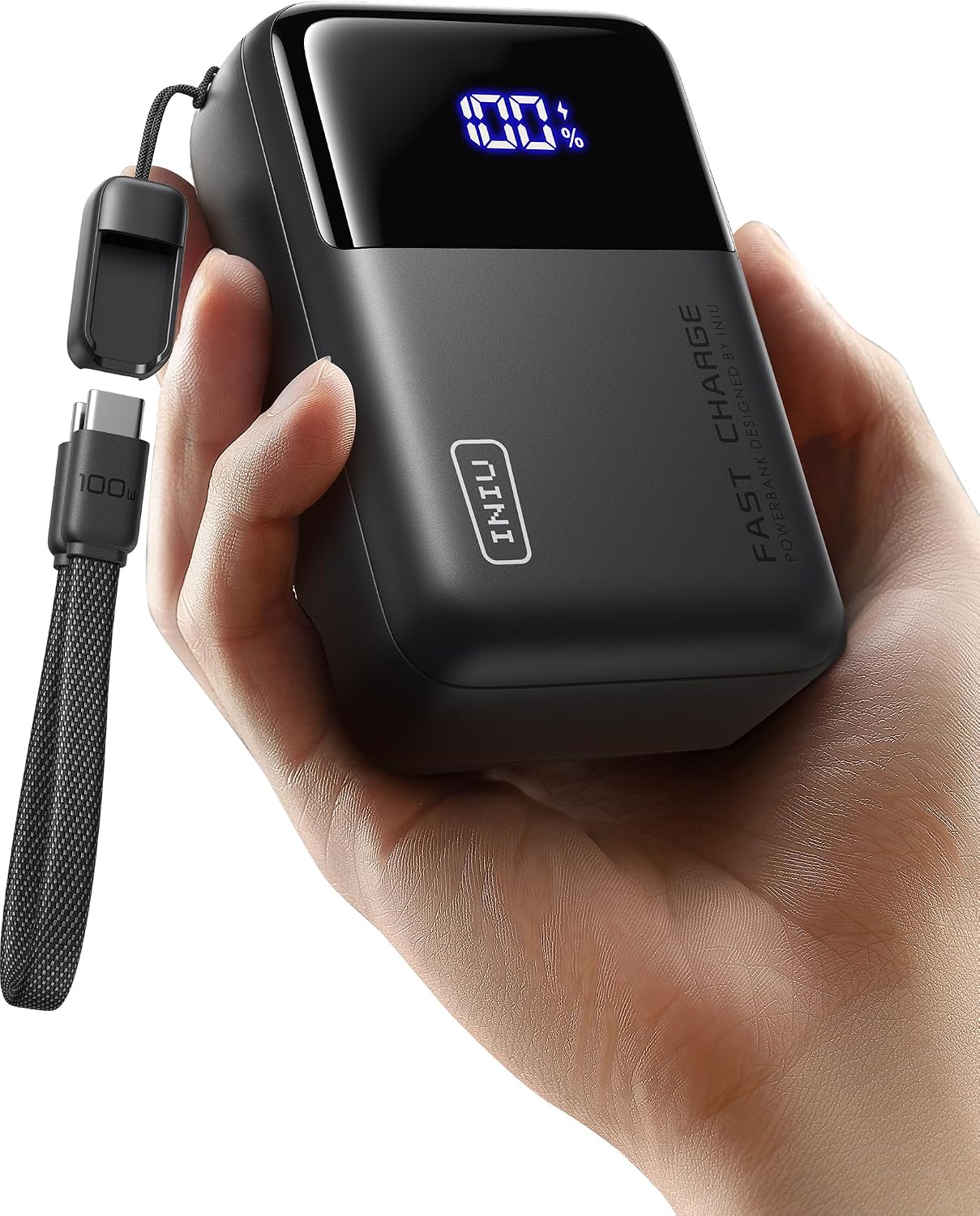
Best Budget: INIU 25,000mAh 100W Compact
The INIU 25,000mAh 100W bank is the budget laptop-capable pack: 100W USB-C output, airline-safe capacity class, and a smaller footprint than soda-can banks. It will not match 140W Anker or UGREEN peaks on a hungry 16-inch Pro, but it is honest 100W PD for Air-class and many 65 to 100W Windows notebooks at the lowest street price on this list.
✓ Pros
- ✓ Real 100W USB-C PD at a budget street price
- ✓ Compact high-density build for bags and trays
- ✓ Airline-safe 25,000mAh capacity class with strong review count
✕ Cons
- ✕ 100W ceiling, not 140W-class for the hungriest Pro laptops
- ✕ Fewer polish extras than Anker Prime (no flagship app suite)
- ✕ Some buyers report warmer multi-device sessions than premium banks
Best for students and travelers who need laptop top-ups without spending triple digits. Skip if your notebook brick is firmly above 100W and you refuse to throttle.
Best Slim Travel: Baseus Blade 20,000mAh 100W
The Baseus Blade 100W is the flat, briefcase-friendly shape: about 20,000mAh, 100W USB-C PD, dual USB-C plus dual USB-A, and a live power display. Capacity is lower than the 24 to 27K banks above, so treat it as a slim day-trip and layover pack rather than a weekend battery.
✓ Pros
- ✓ Flat Blade form factor packs easier than brick-shaped banks
- ✓ 100W USB-C PD for Air-class and many Windows USB-C laptops
- ✓ TSA-friendly capacity class with on-pack power display
✕ Cons
- ✕ ~20,000mAh means fewer full laptop cycles than 24 to 27K rivals
- ✕ Newer listing with less long-term review history than Anker 737
- ✕ 100W ceiling shares the same limit as other mid-watt banks
Best for travelers who prioritize bag thickness over maximum Wh. Skip if you need multi-day laptop autonomy from one charge.
Comparison
| Power bank | Capacity | Max laptop PD | Wh class | Best use | Street price |
|---|---|---|---|---|---|
| Anker 737 PowerCore 24K | ~24,000mAh | 140W | under 100Wh | Best overall daily driver | ~$110 |
| Anker Prime 27K 250W | 27,650mAh | 140W (250W multi) | ~99.5Wh | Flights + multi-device | ~$180 |
| UGREEN Nexode 145W | 25,000mAh | 140W | ~90Wh | Value 140W-class | ~$100 |
| INIU 100W compact | 25,000mAh | 100W | airline-safe class | Budget laptop top-ups | ~$67 |
| Baseus Blade 100W | 20,000mAh | 100W | TSA-friendly class | Slim travel form | ~$83 |
The Bottom Line
Start with the Anker 737 PowerCore 24K when you want the proven 140W laptop bank. Take the Anker Prime 27K when the printed ~99.5Wh flight label and multi-device ceiling matter more than price. Choose the UGREEN Nexode 145W for 140W-class value, the INIU 100W when budget leads, and the Baseus Blade when a flat pack beats another half-cycle of capacity. For wall chargers at a desk, use the Anker 737 vs UGREEN Nexode GaN comparison; for the cable that unlocks these watts, stay on the 100W USB-C cable guide.


