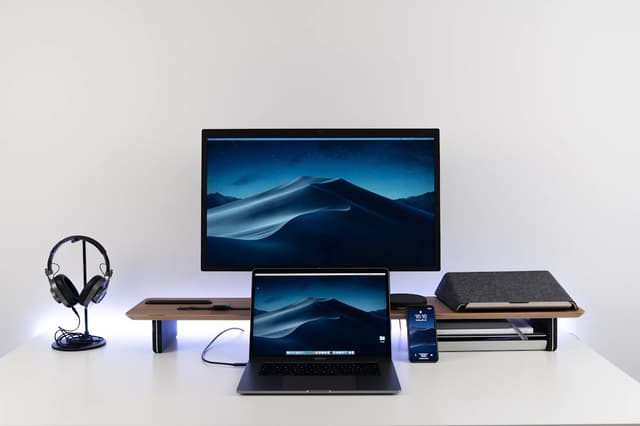
The full parts list and walkthrough for a two-monitor laptop desk: the one spec-sheet check that decides everything, the dock, the cables, the arm, and the settings on both Windows and Mac.
The ranked upgrade path for people who live on Zoom, Meet, and Teams: free fixes first, then a $59 light, a $45 mic, a 4K webcam, and a $40 stand, each with a self-test to prove it is actually your bottleneck.
Five USB mics compared across budgets, from a $30 call upgrade to a $279 broadcast-grade dynamic, with plain-language pickup pattern advice and the real complaint behind each pick.
Five docking stations compared for the home office, from a $41 dual-monitor hub to the $380 Thunderbolt gold standard, with the honest tradeoffs on display bandwidth and laptop charging.
Five external drives compared on price per terabyte, real transfer speeds, and what buyers actually complain about, from a $65 pocket drive to an 8TB desktop archive.
RAID explained in plain English: what a mirror and parity actually protect against, why RAID is not a backup, and the two NAS-rated drives to build your first array with.
A KVM switch runs two or more computers from one keyboard, mouse, and monitor. Here is how they work, what to look for, and the five best HDMI KVM switches.
An HDMI matrix routes several sources to several displays independently. Here is how it works, what to look for, and the four best HDMI matrix switches.